







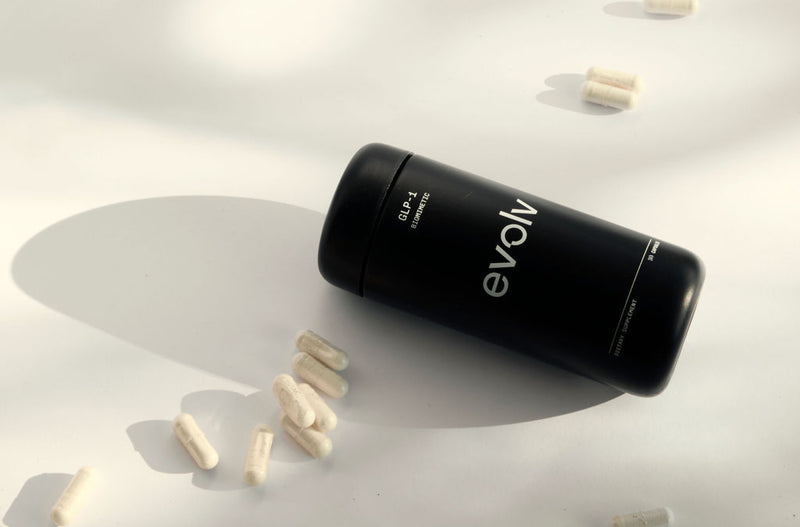


GLP-1 (EV1 Peptide™) Medical and Safety Data
Evolv GLP-1 (EV1 Peptide™)
Introduction
Evolv GLP-1 was developed to deliver the full physiologic power of the GLP-1 pathway in an oral, biomimetic format. Evolv GLP-1 achieves this by leveraging EV1 Peptide™, a novel peptide metabolite expressed in Saccharomyces cerevisiae and composed solely of naturally occurring amino acids.
This page provides an overview on:
-
Safety profile: why its pharmacology and exposure differ fundamentally from synthetic GLP-1 receptor agonists
-
Efficacy rationale: how EV1 Peptide™ mirrors endogenous GLP-1/GIP activity
-
Early study observations: weight, glucose, and tolerability outcomes
Evolv GLP-1 is a dietary supplement, not a drug, yet it was intentionally designed with biomimetic precision to engage GLP-1 pathways in a way that is structurally natural, physiologically relevant, and predictably safe.
What the EV1 Peptide Is
The EV1 Peptide is a bioengineered, yeast-derived peptide composed solely of naturally occurring amino acids.
It is produced using Saccharomyces cerevisiae, a food-safe yeast engineered to express the peptide, rather than through conventional chemical synthesis. It contains no non-natural amino acids and no fatty-acid lipidations.
The peptide is biomimetic, meaning it is designed to work with biology already present in the human body. It was engineered to survive oral delivery, interact with intestinal epithelial cells, undergo enzymatic processing into its active form, bind to human serum albumin, and engage GLP-1 and GIP receptors. Evolv has conducted laboratory work investigating these individual steps, and that testing demonstrated intestinal receptor binding and enzymatic conversion of the inactive peptide into its active form. Evolv’s receptor assays demonstrated activity at both GLP-1 and GIP receptors.
What It Is Not
The EV1 Peptide is not a pharmaceutical GLP-1 and is not an injectable medication. It engages some of the same receptor pathways associated with prescription GLP-1 medications, and shared biological pathways do not make two substances the same.
Evolv GLP-1 does not contain the GLP-1 hormone.
The EV1 Peptide is also not ordinary dietary protein. Its building blocks are familiar to human biology. What is novel is how those amino acids are arranged and how the resulting peptide was designed to move through the body.
Product Category
Evolv GLP-1 is a dietary supplement taken orally as a daily tablet. It is not a drug and it is not a prescription medication.
The EV1 Peptide is a new dietary ingredient, meaning it was not present in the food supply before the current regulatory framework for dietary ingredients took effect. Evolv generated the safety evidence set out below in support of its use at intended intake levels.
Safety Evidence Completed to Date
Designed for Physiologic Support, Not Pharmacologic Burden
Evolv GLP-1 was intentionally designed to mirror natural physiology while avoiding the pharmacologic risks associated with other GLP-1/GIP options.
Non-Clinical Toxicology
The EV1 Peptide was evaluated in 14-day and 90-day preclinical toxicology studies at more than 100 times the intended human exposure.
The 14-day study recorded no mortality and no abnormal findings.
In the 90-day study, the highest dose tested was the No-Observed-Adverse-Effect Level, or NOAEL. At that dose there was no organ pathology and no adverse findings, meaning the study did not identify an observed adverse effect at the highest dose evaluated.
Intravenous Administration of the Active Form
The active form of the EV1 Peptide was evaluated intravenously in preclinical studies. Intravenous administration bypasses the barriers and processing associated with oral administration and exposes the body directly to the test material.
The active form was administered at doses representing more than 18,000 times the proposed human oral exposure. Researchers observed no toxicity, no mortality, and no pathology.
GI Tolerability
EV1 Peptide™ is designed to avoid GI intolerance due to its short half-life and low systemic exposure.
Allergenicity
-
FASTA and Codex Alimentarius analysis: no significant matches to known allergenic proteins.
-
Orally delivered peptides induce oral tolerance rather than immune activation.
-
No expectation of allergic risk.
Technical Function and Mechanism
The figure below provides an overview of the entire functional process: attachment, activation, and distribution process of the orally delivered EV1 Peptide in the body.

Figure 1. Overall schematic diagram of the EV1 Peptide mechanism of action: (1) Ligands on EV1 Peptide engage with the intestinal epithelium once released from the tablet formulation; (2) intracellular enzymes cleave and convert the inactive EV1 Peptide into its active form during transcytosis; (3) the active EV1 Peptide binds to HSA, thereby enhancing its circulating half-life; and (4) EV1 Peptide distributes systemically and binds to its receptors, resulting in enhanced endogenous GLP-1 and GIP receptor signaling.
Here we present data that supports the ability of EV1 Peptide to bind to the intestinal epithelial cells (Figure 2), undergo enzymatic processing in our body (Figure 3), and bind to albumin to enhance its time in circulation (Figure 4).

Figure 2. Interaction of the intestinal receptor binding component of EV1 Peptide with the associated receptors. Soluble protein was extracted from both baker’s yeast (WT) and EV1 Peptide-expressing yeast and was serially diluted as indicated in the graph. The diluted samples were incubated in 96-well plates coated with the targeted receptors. Binding was evaluated using a conventional Enzyme-Linked Immunosorbent Assay (ELISA) by measuring absorbance at 450 nm. WT indicates soluble protein from baker’s yeast; EV1 Peptide indicates soluble protein from EV1 Peptide-expressing yeast; bovine serum albumin (BSA) and non-fat milk were used as negative controls.
The intestinal receptor binding component of EV1 Peptide remained intact and functional in the final processed yeast powder, as demonstrated by the receptor binding ELISA.

Figure 3. Proteolytic cleavage of EV1 Peptide. Purified EV1 Peptide was incubated with the corresponding human enzyme designed to digest the inactive EV1 Peptide into its active form, and proteolytic cleavage was assessed by Western blot analysis. The cleaved by-product that we use for detection and quantification is indicated by a red arrow. S lane contains the standard used as positive control for detectable cleaved portion of EV1 Peptide, - lane contains EV1 Peptide not treated by the enzyme, and + lane contains EV1 Peptide treated by the enzyme.
Proteolytic conversion of the inactive EV1 Peptide to its active form was confirmed by Western blot analysis. Cleavage sites corresponding with the native human enzyme necessary for digestion within the inactive EV1 Peptide were recognized and cleaved when incubated with the corresponding enzyme, resulting in generation of the detectable component of EV1 Peptide at the expected molecular weight.

Figure 4. Interaction of the active EV1 Peptide with GLP-1 and GIP receptors. Binding of the active EV1 Peptide to GLP-1 and GIP was assessed using a G-protein-coupled receptor (GPCR) signaling assay coupled to adenylate cyclase, designed to determine GLP-1 and GIP receptor activation in the presence or absence of HSA. Exendin-4 was utilized as a positive control for GLP-1 receptor activation and native human GIP was used as a positive control for GIP receptor activation.
Both the GLP-1 and GIP receptor binding activity of the active EV1 Peptide was reduced in the presence of HSA compared with its absence. The GLP-1 receptor binding activity of the active EV1 Peptide was reduced by approximately 10-fold in the presence of HSA compared with its absence, indicating strong binding affinity between HSA and the albumin-binding domain of the active EV1 Peptide. Potencies at both the GLP-1 and GIP receptors remained high despite the reduction in potency driven by the binding to HSA, demonstrating both that the half life of EV1 Peptide is prolonged and affinity to the incretin receptors at physiologically relevant levels is maintained. Positive controls did not demonstrate any reduction in potency in the presence of HSA due to their lack of binding affinity to HSA, further confirming that the reduction in potency for EV1 Peptide in the presence of HSA for GLP-1 and GIP is driven by binding to HSA.
Early Human Data
Over a 3-week period, 51 individuals taking 1–2 tablets per day reported measurable results. Self measured data shows consistent and meaningful weight loss, averaging ~9 lbs in 3 weeks (≈3 lbs per week).
These outcomes demonstrate strong early signals of effectiveness across a broad participant group.


† Data represents self-reported weight loss from 51 participants taking 1–2 tablets daily. Observational dataset, not a controlled clinical trial.
Case Observation: Early Human Data (with CGM)
Population: Baseline markers consistent with mild pre-diabetes (fasting glucose 96–105 mg/dL, GMI ~5.8%, 40 nmol/mol)
Dosing: Escalation from ~0.5 tablet twice daily (Days 1–3) to 1 tablet twice daily (Days 4–18)
Pre-treatment:
-
Fasting glucose: 96–105 mg/dL
-
GMI: 5.8%
-
Status: mildly pre-diabetic
During trial:
-
Fasting glucose: 90–100 mg/dL
-
Average glucose: 99–100 mg/dL
-
GMI: 5.7% (39 nmol/mol)
-
Weight decreased from 150 lbs to approximately 140 lbs within 3 weeks

Continuous Glucose Monitoring (CGM) Data

Fasting glucose and GMI fell below pre-diabetic thresholds, accompanied by a parallel reduction in weight, which then stabilized during the trial window.
Human Clinical Research
Evolv GLP-1 was evaluated in a randomized, controlled third-party human clinical study. The product was well tolerated. Two adverse events were recorded in the Evolv group during the study: nausea and nasal congestion.
The results of Evolv’s 12-week clinical study were published on medRxiv on 24 October 2026 (read the publication: https://www.medrxiv.org/content/10.64898/2026.10.22.26365662v1). In the completed 12-week analysis, only two (2) adverse events/instances were reported.
Interim Clinical Study Data
A midway study data analysis shows consistent weight loss trends at both 6 and 8 weeks. The experimental group showed a −1.22% body weight reduction at week 6 and −2.43% at week 8 compared to control. Waist reductions were also recorded in the most recent data readout, with an observation of 1.21% and 4.02% reduction in waist measurements at 6 and 8 weeks relative to control respectively.
Data presented on reduction in waist measurements provides more confidence on the biased loss of fat in participants who are losing weight, as significant reductions in waist measurements coinciding with weight loss suggests loss of abdominal fat such as dangerous visceral fat which surrounds the organs. Moreover, among participants in the experimental group who lost less weight overall still saw reductions in waist measurements exceeding those observed in the control group, providing further evidence that weight lost is primarily fat, with lean muscle mass retained in healthy weight or overweight individuals who use EV1 Peptide.
Visual Summary of Weight Loss
The charts below illustrate percentage body weight change and percent change in waistline measurements at 4, 6, and 8 weeks.


Expectations for Physicians
-
Not a drug: Evolv GLP-1 is a dietary supplement.
-
Biomimetic, not synthetic: EV1 Peptide™ mirrors natural incretin biology using only amino acids found in human proteins.
-
Safety: supported by preclinical toxicology, long history of yeast consumption, and comparative pharmacology.
-
Intended use: daily dietary intake supporting appetite regulation and metabolic balance.
Conclusion
Taken together, the non-clinical toxicology data and the human clinical data support a reasonable expectation of safety for the EV1 Peptide at its intended intake levels. That is also the conclusion of the underlying medical brief.
Evolv’s scientific program is ongoing, and this page will be updated as further evidence is generated.
Frequently Asked Questions
Is the EV1 Peptide a drug?
No. The EV1 Peptide is a new dietary ingredient used in Evolv GLP-1, a dietary supplement. It is not a drug and it is not an injectable medication.
What is the EV1 Peptide composed of?
Naturally occurring amino acids only. It is produced using Saccharomyces cerevisiae, a food-safe yeast engineered to express the peptide, and contains no non-natural amino acids and no fatty-acid lipidations.
What safety testing has the EV1 Peptide undergone?
14-day and 90-day preclinical toxicology studies at more than 100 times the intended human exposure, with the highest dose in the 90-day study identified as the NOAEL; intravenous preclinical studies of the active form at more than 18,000 times the proposed human oral exposure, with no toxicity, mortality, or pathology observed; and a randomized controlled human clinical study in which the product was well tolerated.